I wrote Lynne McNeill, the folklore professor at USU that Dr. Eliason suggested to me as a good person to contact about Digital Folklore, last night and she responded this morning! She was amazingly helpful! It has totally renewed my interest in and excitement for my subject, which was flagging after my muse and inspiration left me to myself last night while trying to rewrite my submission.
I told her the direction I am heading in (to advocate the remix culture of the internet being the perfect venue for both the dissemination of existing traditions/lore and the creation of new genres of folklore and thus requiring more attention from folkloristics) and she confirmed that I'm heading in the right directions, saying: "Right now, your question of remixing is a good one--not only are traditional forms of folklore being revived on the Internet, but new forms, like image macros and memes, and coming to prevalence. There's not much general writing about it all yet--lots of conference papers and lots of individual case studies as articles and book chapters, but no prevailing work on it other that Trevor's book."
I asked her to point me in the right direction as far as sources for my research of folklore on the internet and methodology for studying Internet folklore, and told her what sources I had already found. She confirmed that I had "found many of the main resources out there" and gave me additional direction. She not only recommended a book and certain articles, but also attached PDF copies of those articles to the email! Talk about helpful! (and of course, I sent her a huge thank you email right back).
Showing posts with label social proof. Show all posts
Showing posts with label social proof. Show all posts
Friday, March 30, 2012

Thursday, March 8, 2012
Repurposing Beginnings
I've decided to focus on the folklore aspect more in my paper. As I mentioned before, I think it would be interesting to see how correct I am in my assumption that folklorists are resistant to breaking from tradition. So I stopped by my folklore professor's office for a chat.
We talked about whether he considers things like memes, themed photographs, and some Pintrest stuff folklore as well as stories people tell on their blogs and such. He said the line is fuzzy. It's not that he is resistant to changing the definition of folklore; just that he doesn't really think about it much. He said most people in his field are gathering folklore via the traditional means (face-to-face) and the same goes for the majority of his students. He hypothesized that this might be because folklore archives and other collection methods just haven't updated to store these kinds of things: in the William A Wilson folklore archive here at BYU, you have to have a physical copy of your project. These things just aren't stored online. So, he said, for example, you couldn't use an animation or a Youtube video. They're not stored online or digitally.
He's not sure how others in his field feel about the "issue" and so to his knowledge it's not really divided into two camps of opinions, more just that some might choose to explore this avenue, but most don't.
He did give me a list of people that I should talk to and one book to check out:
The book is called Folklore and the Internet and contains essays written by a number of folklorists. It is edited by Trevor Blank.
Jaquie Thursby here at BYU could tell me more about the use of folklore in literature/Shakespeare.
Greg Kelly is a contact of his at Guelph University in Canada who studies folklore online.
And I'm most excited to talk to Lynne McNneal is up at Utah State. She is all over the eFolklore idea.
We talked about whether he considers things like memes, themed photographs, and some Pintrest stuff folklore as well as stories people tell on their blogs and such. He said the line is fuzzy. It's not that he is resistant to changing the definition of folklore; just that he doesn't really think about it much. He said most people in his field are gathering folklore via the traditional means (face-to-face) and the same goes for the majority of his students. He hypothesized that this might be because folklore archives and other collection methods just haven't updated to store these kinds of things: in the William A Wilson folklore archive here at BYU, you have to have a physical copy of your project. These things just aren't stored online. So, he said, for example, you couldn't use an animation or a Youtube video. They're not stored online or digitally.
He's not sure how others in his field feel about the "issue" and so to his knowledge it's not really divided into two camps of opinions, more just that some might choose to explore this avenue, but most don't.
He did give me a list of people that I should talk to and one book to check out:
The book is called Folklore and the Internet and contains essays written by a number of folklorists. It is edited by Trevor Blank.
Jaquie Thursby here at BYU could tell me more about the use of folklore in literature/Shakespeare.
Greg Kelly is a contact of his at Guelph University in Canada who studies folklore online.
And I'm most excited to talk to Lynne McNneal is up at Utah State. She is all over the eFolklore idea.
Thursday, March 1, 2012
Paper Reflections
Here's the link to what I would call my final paper, but I know I'll be editing, changing focus, and taking it in new directions before April comes around.
My writing process:
With this paper, in contrast to so many others I've written in college, I wrote slowly. A lot of the information I gathered while writing blog posts ended up in my final paper (some of it word-for-word from my blog). I wrote in hour or two hour chunks, because that's all that was afforded to me with little Bracken needing my attention. I ended up really enjoying writing this way. I was not to worn out from sitting down and writing an entire day and a half and staying up all night the day the paper is due, which is how I usually write. I feel like I really benefited from being able to roll my topic around in my head for so long and articulate my thesis to so many people during social proof. My thesis changed over and over, and I foresee it changing again.
Some things Dr. Burton commented on while reading my paper:
I didn't really ground my paper in a good, solid close reading of the text. My focus was on contextual evidence, and my paper may have benefited from a good character or thematic analysis. But as it is, I believe my argument really does center around context, so I may not go back and add this in.
This has a lot to do with my intended audience for the paper, which was another thing Dr. Burton asked about. He said my paper seemed divided in its function and purpose: was this a Shakespeare paper with a little application to modern times or an argument focusing on its audience as academics with a little history to back it up. I'm thinking, ironically I know since we're in a Shakespeare course, that it is actually more of the latter.
My writing process:
With this paper, in contrast to so many others I've written in college, I wrote slowly. A lot of the information I gathered while writing blog posts ended up in my final paper (some of it word-for-word from my blog). I wrote in hour or two hour chunks, because that's all that was afforded to me with little Bracken needing my attention. I ended up really enjoying writing this way. I was not to worn out from sitting down and writing an entire day and a half and staying up all night the day the paper is due, which is how I usually write. I feel like I really benefited from being able to roll my topic around in my head for so long and articulate my thesis to so many people during social proof. My thesis changed over and over, and I foresee it changing again.
Some things Dr. Burton commented on while reading my paper:
I didn't really ground my paper in a good, solid close reading of the text. My focus was on contextual evidence, and my paper may have benefited from a good character or thematic analysis. But as it is, I believe my argument really does center around context, so I may not go back and add this in.
This has a lot to do with my intended audience for the paper, which was another thing Dr. Burton asked about. He said my paper seemed divided in its function and purpose: was this a Shakespeare paper with a little application to modern times or an argument focusing on its audience as academics with a little history to back it up. I'm thinking, ironically I know since we're in a Shakespeare course, that it is actually more of the latter.
Monday, February 27, 2012
Teaser
Using the following information in my paper. Bet you can't wait to read that!


Here's a link to the article about the rat carcass in a Mountain Dew if you're interested -- of course you are, admit it.


More Tweethis Results
Conversation about my original Tweethis on Facebook:

Reactions to my "Outline" / Elaborated Thesis on Facebook:


Saturday, February 25, 2012
New Facebook Tweethis
Now I've gone the complete opposite direction (too long) and prolly no one will post on this either. LOL.


I also posted a link to facebook of my rough rough draft. How brave is that?!

Shout Out to Alicia
A huge thanks to Alicia for her comments on my draft! Not only did she read and encourage me in the direction I was heading but her comments were actually thoughtful suggestions that have majorly influenced my paper. For example, her suggestion to "back the two sides (of my argument) up equally" made me realize I should reach out to some good social sources for the flip side of my argument. And her comment that she "like(s) that I incorporated more than one Shakespeare play" is awesome because I was debating taking the second one out. Now that I know it makes a difference, I most certainly won't!
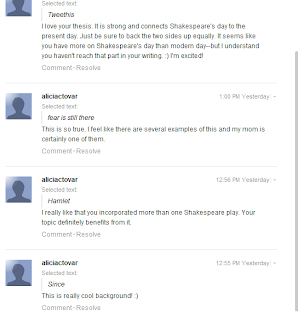


You best believe I hopped right on over to her draft to leave her some, what I hope will be, useful comments! That's a major benefit of social media. Maybe it's a good idea to help out people via social media that you specifically want to help you out! :)
My comments on Alicia's Rough Draft:


Tweethis Succes
So, I connected my Facebook and Twitter feeds so that when I posted my tweethis to Twitter, it posted automatically to Facebook.


I got two likes on Facebook. It was a little encouraging, but something about one being my mother-in-law and one being a close friend, didn't make it feel like any big success. I'm thinking that 140 characters is just not enough to invite attention on Facebook. Not enough at all. I'm going to post a much longer thesis on Facebook as well as an invitation for others to comment on my post following Ellie's example.

BUT!!!
I did have something amazing happen with my Tweethis on Twitter!! Someone retweeted me! Someone I don't even know and who doesn't follow me... so I'm hypothesizing they must have found me in a search. Well, you better believe I started following them! I retweet! I'm so honored! sniff* Thank you GallowayNightSky!

And you better believe I thanked him:

Thursday, February 9, 2012
Shakespeare in the Ruins Reply
Yes!!!! It worked! I'm now excited to look for evidence of scholarly scorn towards A Midsummer Night's Dream and to take a look at The Striker (see below). This social proof thing is kind of exhilarating when it works. I've been in several of Dr. Burton's classes and this has always been the aspect of his teaching that intimidates me most and always seems to fall by the wayside, but not so this time!
Here's Kevin's response:
Hi Bri!
How great to receive your e-mail! It's always a relief to know that someone is reading those things...
I love your thesis, and I definitely concur. As a matter of coincidence, the next show that SIR will be "stripping down" for this fall's tour is A Midsummer Night's Dream which, as I'm sure you know, is bubbling over with folklore and fairy tale references, and is almost certainly Shakespeare's most popular and most produced comedy. In my experience, it also tends to be the subject of a certain level of scorn among "serious" scholars as well as actors, which, as you appear to be suggesting, is likely no coincidence.
I would be thrilled if you decided to reference my story, particularly if it in any way helps to promote Shakespeare in the Ruins (perhaps a link to the website...)
Let me know if there's anything you need me to do!
Thanks Again,
Kevin
Artistic Co-Chair, SIR
---
Hi Bri,
As a bit of a sidebar, I wonder if you're familiar with Caryl Churchill's play "The Skriker"? It's an incredibly complex, fascinating treatment of traditional English folklore for adult contemporary audiences. If you haven't already read it, I highly recommend it.
Cheers,
Kevin
Here's Kevin's response:
Hi Bri!
How great to receive your e-mail! It's always a relief to know that someone is reading those things...
I love your thesis, and I definitely concur. As a matter of coincidence, the next show that SIR will be "stripping down" for this fall's tour is A Midsummer Night's Dream which, as I'm sure you know, is bubbling over with folklore and fairy tale references, and is almost certainly Shakespeare's most popular and most produced comedy. In my experience, it also tends to be the subject of a certain level of scorn among "serious" scholars as well as actors, which, as you appear to be suggesting, is likely no coincidence.
I would be thrilled if you decided to reference my story, particularly if it in any way helps to promote Shakespeare in the Ruins (perhaps a link to the website...)
Let me know if there's anything you need me to do!
Thanks Again,
Kevin
Artistic Co-Chair, SIR
---
Hi Bri,
As a bit of a sidebar, I wonder if you're familiar with Caryl Churchill's play "The Skriker"? It's an incredibly complex, fascinating treatment of traditional English folklore for adult contemporary audiences. If you haven't already read it, I highly recommend it.
Cheers,
Kevin
Monday, February 6, 2012
Settling on a Paper Topic
I seriously love the thumbnail Youtube chose for this video ... oh so flattering.
This is a 3 min video of me brainstorming my paper topic. I think I've finally landed on something.
So because of the research I've done today, I have a few people I can talk to for my "social proof" - finding an audience who is invested in what I'm talking about already and talking with them about my ideas/ getting feedback. I'm super nervous to even approach these people, but here's the reasons why I think each of them might work and as soon as I can think of interesting questions to ask them and write what I consider a worthy email about my ideas, I will.
Subscribe to:
Posts (Atom)